What is the difference between 3D print and silk flowers? This question matters when comparing China’s top 10 artificial flower manufacturers. Both options can brighten a room, yet their materials, textures, production methods, and long-term value differ sharply. A 3D-printed flower is built layer by layer from materials such as PLA, PETG, or resin. Silk flowers usually use polyester fabric, wire stems, foam centers, and painted finishes. One is digitally formed. The other is shaped by textile craftsmanship.
Dr. Hod Lipson, a robotics and manufacturing expert at Cornell University, said, “What 3D printing does is allow you to create things that you can’t make any other way.” His observation helps explain the strongest advantage of 3D-printed flowers: unusual petals, precise symmetry, custom sizes, and repeatable designs. They may resemble a sculptural object more than a soft botanical replica. Silk flowers feel different. Their folded petals catch light gently, while flexible stems create a more natural movement in a vase.
The differences are not always obvious online. They appear in your hands. A printed petal can feel firm, ridged, or slightly plastic. A silk petal may feel fabric-like but show visible seams or fraying edges. Durability also depends on sunlight, heat, dust, and cleaning habits. Neither choice is perfect. 3D printing can leave layer lines, while silk flowers may lose color or collect dust quickly. This guide compares China’s leading options through practical details, including realism, customization, cost, maintenance, and environmental considerations. Fancy labels are not enough. Actual quality needs closer inspection.
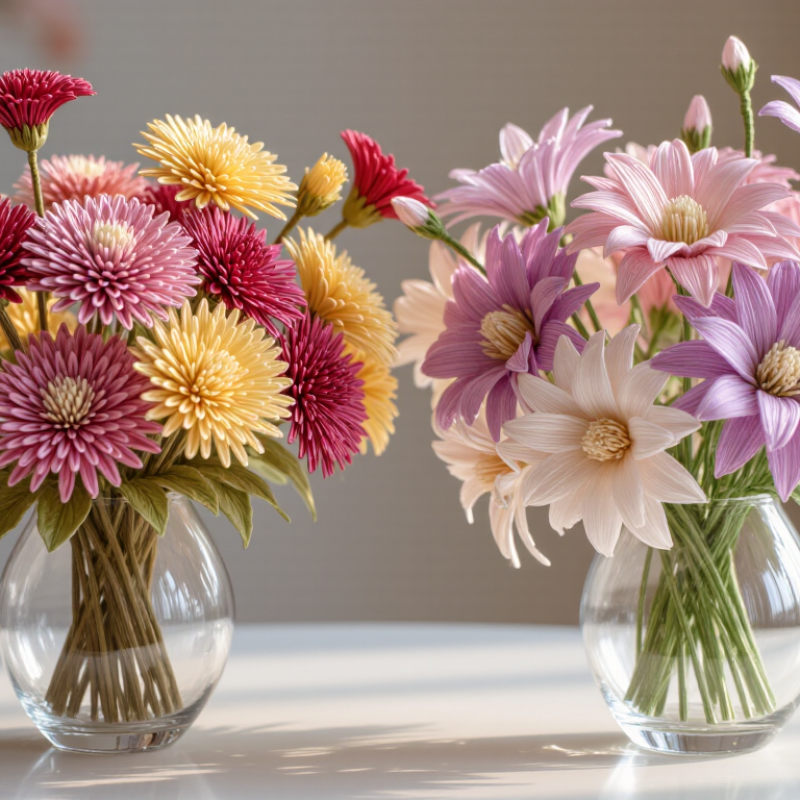
A 3D-printed flower is a digitally designed object made layer by layer from materials such as PLA, resin, or nylon. Its petals can include sharp veins, hollow structures, or unusual geometric forms. A digital file controls the shape, while temperature and printing speed influence surface quality. Small ridges may remain visible.
Silk flowers are usually fabric-based artificial flowers, although many contain polyester rather than genuine silk. Makers cut, dye, heat, and shape the fabric around stems and centers. The petals feel softer and often show slight color variation. That variation can make an arrangement feel less mechanical. It can also create uneven edges.
According to the 2024 Wohlers Report, the global additive manufacturing industry reached about 20 billion US dollars in 2023. This figure covers many sectors, not flowers alone. Grand View Research has also reported steady growth in the global artificial flowers market, supported by durable decorative products and low-maintenance interiors. These figures show wider demand, but they do not prove that one flower type is better. In practical testing, printed petals resist moisture well, while fabric petals usually provide more natural movement. I would question any claim of perfect realism. 3D printing still struggles with soft folds, and silk flowers can collect dust between fibers. The difference is tactile, not merely visual.
| No. | Comparison Dimension | 3D-Printed Flowers | Silk Flowers |
|---|---|---|---|
| 1 | Primary Material | Usually made from thermoplastic filament such as PLA, PETG, ABS, or flexible TPU. The final properties depend on the selected polymer. | Usually made from woven or molded polyester, nylon, rayon, or blended synthetic fabric. Despite the common name, most decorative “silk flowers” are not made from natural silk. |
| 2 | Production Method | Created layer by layer from a digital 3D model. The printer deposits or cures material according to programmed toolpaths. | Formed through fabric cutting, heat shaping, molding, dyeing, and manual or semi-automated assembly around stems and centers. |
| 3 | Typical Production Time | A small flower commonly takes about 30 minutes to several hours to print, depending on size, layer height, infill, nozzle size, and printer speed. Assembly may add extra time. | A simple flower can be assembled relatively quickly, while detailed flowers with layered petals, coloring, and wired stems may require several minutes or longer per piece. |
| 4 | Shape and Design Flexibility | Highly adjustable through CAD software. Petal thickness, openings, stem geometry, texture, and scale can be changed without creating a new physical mold. | Offers broad visual variety, but changes to a complex shape may require new cutting patterns, molds, tooling, or manual production steps. |
| 5 | Surface Texture and Appearance | May show visible layer lines, seams, or a uniform plastic surface. Fine layer settings, post-processing, painting, or special filaments can improve the finish. | Normally provides a softer, fabric-like appearance with folds, translucency, and color variation that can resemble natural petals more closely. |
| 6 | Water and Moisture Resistance | PLA, PETG, ABS, and TPU are generally not water-soluble. However, seams, coatings, adhesives, metal wires, and electronic components may still be affected by prolonged moisture. | Synthetic fabric usually tolerates light moisture, but water may cause staining, color bleeding, wrinkling, adhesive failure, or loss of shape. It should not be treated as fully waterproof. |
| 7 | Heat Resistance | Material-specific. PLA commonly begins to soften around 55–60°C, while PETG and ABS generally tolerate higher temperatures. Direct sunlight or hot vehicles can deform some printed flowers. | Synthetic fabrics can melt, shrink, scorch, or lose their shape when exposed to high heat. Heat from irons, heaters, open flames, and strong sunlight should be avoided. |
| 8 | Outdoor and UV Performance | Outdoor performance depends on the polymer, pigment, coating, and print structure. Extended UV exposure can cause fading, brittleness, or surface degradation in some filaments. | Polyester and nylon may be suitable for sheltered outdoor decoration, but prolonged UV exposure can fade dyes and weaken fibers. UV-resistant treatment improves, but does not guarantee, long-term color stability. |
| 9 | Maintenance and Cleanability | Rigid printed surfaces can usually be dusted or gently wiped. Complex lattice structures may collect dust, and painted or coated surfaces require gentler cleaning. | Fabric petals collect dust more readily and are often cleaned by gentle brushing, low-pressure air, or careful wiping. Aggressive washing can distort petals and damage dyes or adhesives. |
| 10 | End-of-Life and Environmental Considerations | Plastic parts can remain persistent in the environment. PLA is industrially compostable only under suitable controlled conditions; it does not normally compost quickly in home compost or soil. | Most synthetic textile flowers are not readily biodegradable and may contain mixed fabrics, wire, foam, and adhesives, making separation and recycling difficult. Reuse is often the most practical option. |
Note: Performance varies according to material formulation, construction, coatings, processing settings, and intended environment.
They are usually made from PLA, resin, nylon, or flexible polymers. A digital file guides each petal, layer by layer.
Makers cut, dye, heat, and shape fabric around stems and flower centers. A fabric flower.
Fabric petals usually move more softly and reflect light gently. 3D-printed petals can show sharp details, but they may feel rigid.
Not always. Small layer lines or ridges may remain visible on petals and stems. These marks are not automatically defects.
Check layer marks, joint strength, surface finish, and stem thickness. Handle several pieces. One sample can hide uneven quality.
Examine stitching, petal edges, color variation, and stem flexibility. Look between the petals.
They suit modern desks, shelves, and arrangements needing unusual shapes or precise colors. They also handle moisture fairly well.
They suit weddings, restaurants, and rooms needing soft movement for several months. However, dust can collect between fibers, and sunlight may fade the fabric.
Choose printed flowers for geometric detail and color experimentation. Choose fabric flowers for softness and familiar realism. My preference might change after touching them. Photos cannot show temperature, texture, or assembly marks.
Some materials may smell after unpacking. Air them out before placing them near children or pets. A small precaution.
3D-printed flowers and silk flowers are two decorative options with different production methods, materials, and visual qualities. 3D-printed flowers are created in China by converting digital designs into layered forms, usually with polymers or other printable materials. This process allows precise shapes, customized colors, detailed textures, and consistent results. Silk flowers, in contrast, are manufactured from fabric, synthetic fibers, wire, and finishing materials. Their petals are cut, shaped, assembled, dyed, and treated to create a soft, natural appearance.
What is the difference between 3D print and silk flowers? The main differences involve texture, flexibility, durability, and style. 3D-printed flowers often have a structured surface, stronger shape retention, and greater design flexibility, while silk flowers provide a more traditional, fabric-like feel and realistic movement. 3D-printed designs may be easier to customize and clean, whereas silk flowers can offer warmer visual softness. The best choice depends on the intended setting, budget, desired appearance, maintenance needs, and whether customization or a natural textile effect is more important.

 Maison Flower